
Most Lake Erie boaters handle the dock-to-destination gap one of four ways: they walk it, they rent a golf cart at the islands, they rent a bike, or they carry folding bikes on the boat. Which one works comes down to where you dock and how much stowage you are willing to give up.
The gap between your slip and everywhere else
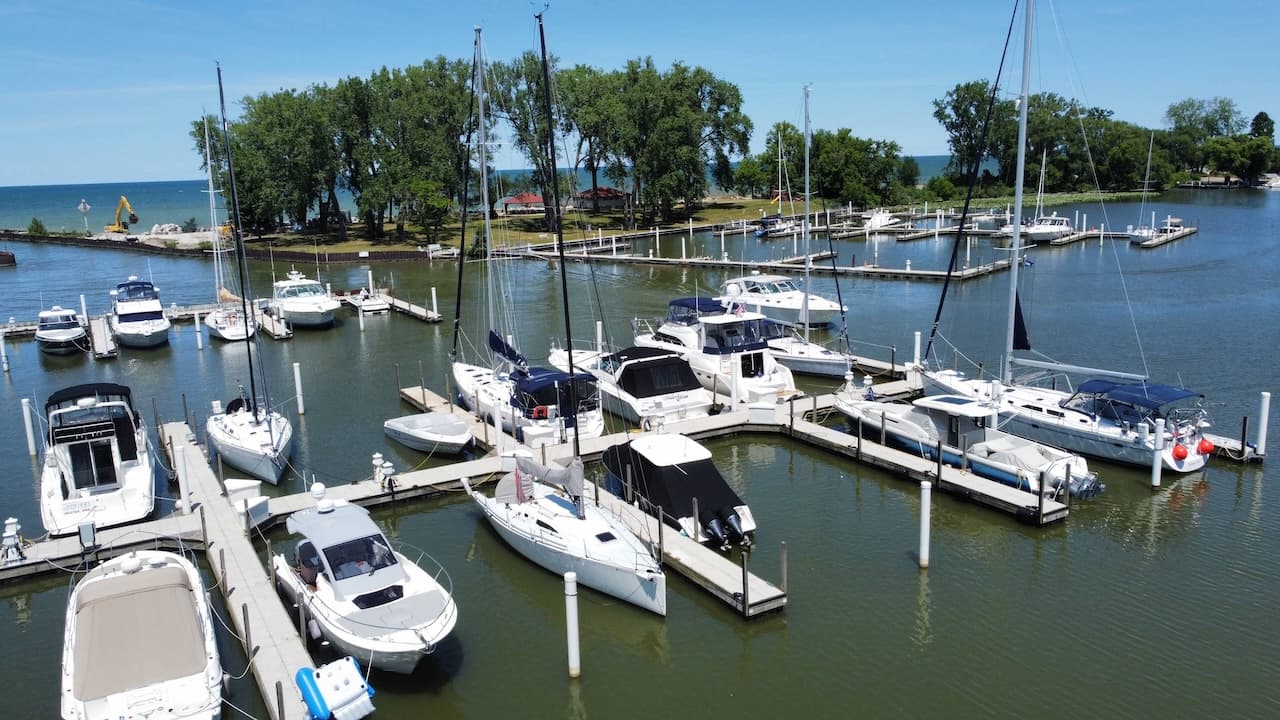
At the larger Cleveland marinas, the walk from the parking lot to the far docks can run 15 or 20 minutes. Nobody minds it on the way in with a cooler. At 2pm when you want lunch and the car is at the other end of the lot, it matters.
At the islands the problem changes shape. You arrive by water, so there is no car at all. Put-in-Bay, Kelleys, and Middle Bass put you on the dock with whatever you brought aboard.
Getting around Put-in-Bay and the islands
South Bass Island is roughly 3.5 miles long and 1.5 miles wide. The village around the docks is compact and easy to walk. Everything past it, including the state park, the wineries, and the quieter east side, is a real ride in July heat.
Golf carts are how most people solve this. There are close to 1,000 of them on the island and a dozen rental outfits, with the season running mid-April through October. June through August they sell out daily.
Bike rentals are the cheaper fallback, generally around $4 an hour or $16 for the day. Availability holds up better than carts, though the bikes are basic cruisers.
Kelleys Island is larger and much quieter, with fewer rental operations running. Middle Bass has less still. Showing up at either without a plan is how you end up walking.
Anchoring out changes the math again. If you are on the hook in the bay rather than in a slip, you are taking the dinghy in and arriving on foot with no way to carry a bike, so the rental counter is the only option left.
Getting around the Cleveland marinas
This is a smaller problem with a simpler fix. Your car is usually already there. It is just parked a long way off, or you would rather not move it and lose the spot.
Whiskey Island sits at the mouth of the Cuyahoga, so the Flats are close. Edgewater backs up against Detroit Shoreway and Gordon Square. E. 55th is a longer haul to anything worth walking to, and Mentor Harbor is mostly residential around it, so plan on the car for dinner.
A bike turns all of that from a decision into something you just do. Plenty of Cleveland boaters skip the on-board question entirely and keep a cheap bike locked at the marina all season, which solves the parking-lot walk without giving up a locker. It works better at gated facilities than at public docks.
Where an e-bike earns its space
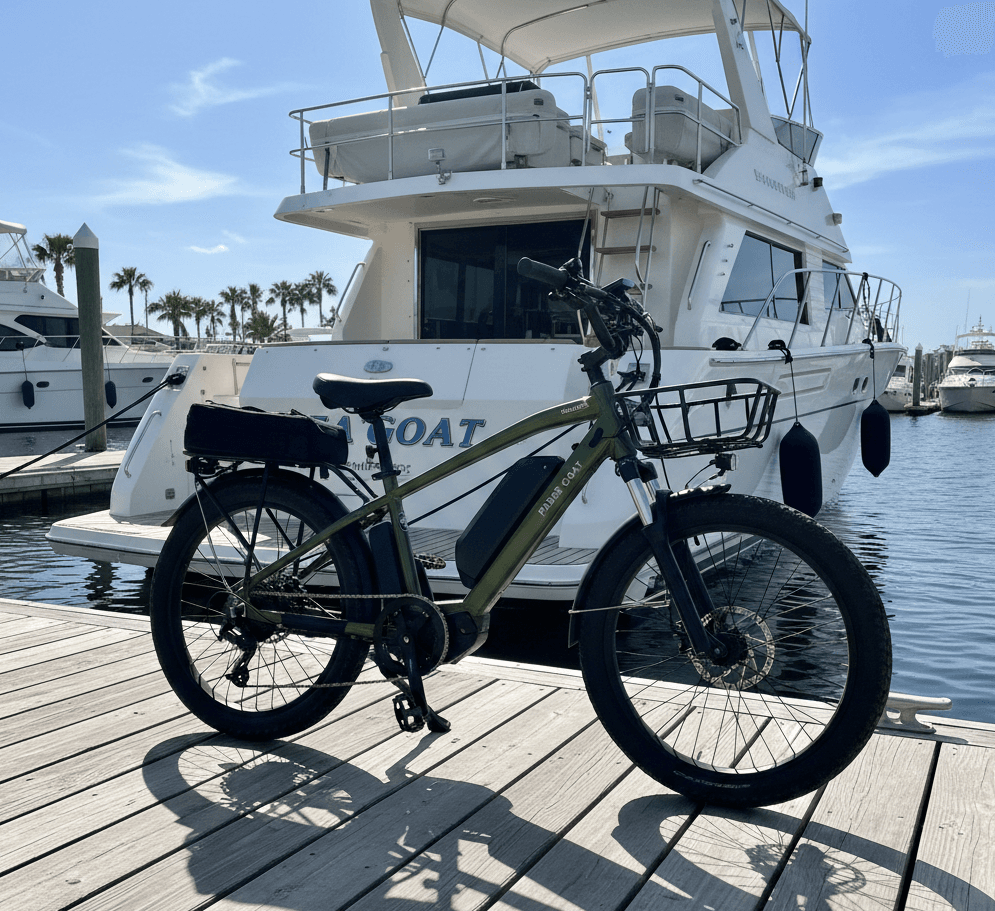
An e-bike is worth the weight and the charging when the ride runs past a mile or two, when there is a cooler or groceries on the back, or when it is 88 degrees and you would like to arrive at dinner dry.
Most models are rated 20 to 40 miles per charge. On an island 3.5 miles end to end, that is several days of riding between plug-ins. Class 1 and Class 2 bikes cap assist at 20 mph, which is plenty on island roads shared with golf carts.
What actually fits on your boat
Weight is usually the binding constraint. Folding e-bikes run 45 to 70 pounds, and lifting that over the gunwale or up a dock ladder by yourself is harder than finding somewhere to stow it.
Where it goes depends on the boat. A 40-foot cruiser has a lazarette or a forward berth that will swallow one folded bike, sometimes two. On anything smaller it rides on deck or on a rail mount, out in the rain and the spray.
Lake Erie is freshwater, so a drivetrain will not disappear the way it would on the coast. It still wants a rinse and a wiped chain after a wet crossing.
Plan for two bikes if you boat with someone. The second one is what forces a real decision about which locker gets emptied.
Charging a lithium battery on a boat
Lithium-ion battery fires have become a live concern in the marine world, and marina operators, insurers, and fire agencies have all been publishing on it. A thermal runaway event inside a closed locker on a fiberglass boat is not something you put out with the extinguisher under the helm.
The basic practice:
- Charge on the dock or ashore, in open air, where you can see it.
- Use the charger that came with the bike.
- Do not charge unattended overnight in the cabin.
- Pull the battery off the frame and take it with you if the bike lives on deck.
- Retire any battery that has swollen, been dropped hard, or gone in the water.
Buying an e-bike for the boat
Four specs matter more than the rest for boat use: a folding frame, a weight you can lift, a removable battery, and fenders. The removable battery does double duty. It takes 8 or 10 pounds off the lift and it lets you charge on the dock instead of running a cord out to the bike.
If you want to talk it through with someone before you buy, Rad Moto USA is who we recommend. They sell and service e-bikes and e-motos out of Portsmouth, New Hampshire, and they ship nationwide. Plan on a ship-to-your-door purchase rather than a showroom visit.
Does this change the boat you should buy?
Sometimes. Buyers who plan on island runs start asking about lazarette volume, swim platform size, and how high the gunwale sits above a floating dock, which are not questions most listings answer.
If a bike on board is part of how you picture using the boat, say so while you are still shopping. It changes which 32-footer makes sense. Our guide to what size boat works on Lake Erie covers the stowage side, and the used boat buying guide covers what to check once you are aboard.
Common questions
Can you bring an e-bike to Put-in-Bay on your own boat? Yes. Nothing restricts carrying one over, and they are a common sight at the village docks in summer. Sort out charging with whoever you are docking with.
Do you need to register an e-bike in Ohio? No. Ohio treats an e-bike that meets the state definition, meaning fully operable pedals, a motor under 750 watts, and Class 1, 2, or 3 performance, as a bicycle. No license, no plate, no registration, no insurance. Class 3 riders have to be at least 16, and everyone on a Class 3 has to wear a helmet.
How much storage does a folding e-bike need? Figure a folded envelope close to a large marine cooler stood on end, roughly 3 feet by 2 feet by 2 feet. Fat-tire folders run bigger in every dimension.
Should you rent a golf cart or bring bikes to Put-in-Bay? Rent the cart if you have 4 or more people, kids along, or a full day of stops planned. Bring bikes if it is 2 of you, you are staying a night or two, and you want to move on your own schedule.
Can you charge an e-bike at a marina? Usually, at a slip with shore power. Transient docks are hit or miss. Ask when you reserve.
Buying or selling on Lake Erie
Northern Boat Brokerage handles full-service brokerage on the Cleveland lakefront and across the lake, from Rocky River to Sandusky and Port Clinton. Browse current listings, read the Cleveland marina guide if you are still picking a home dock, or list your boat with us.
Questions about buying or selling a boat in Cleveland? Contact us or call (216) 780-5988.